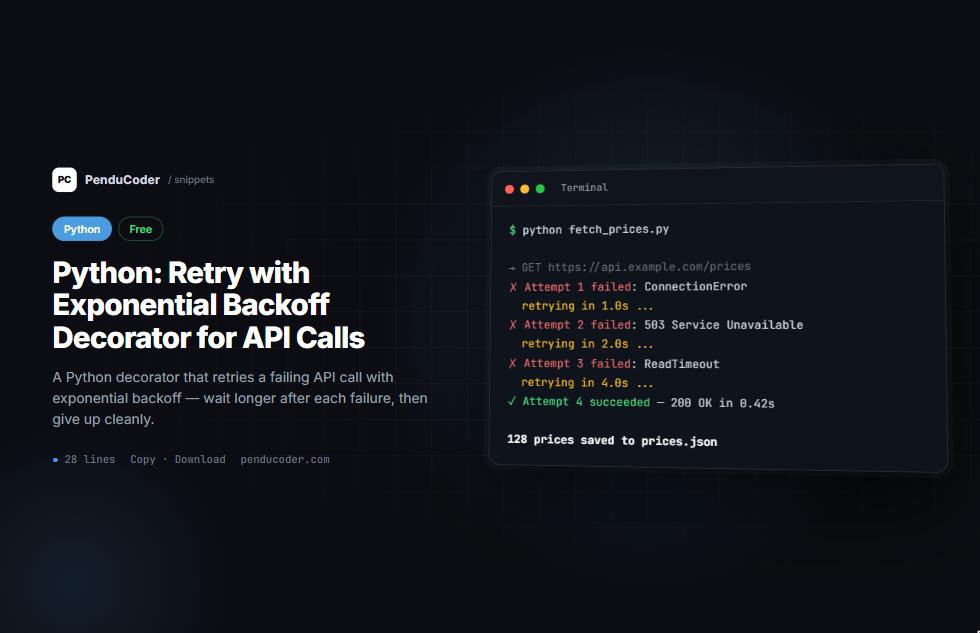
External APIs fail more often than you expect: rate limits, timeouts, a server restarting for two seconds. A script that gives up on the first error breaks for no good reason; a script that retries immediately in a tight loop makes things worse. This snippet is a reusable Python decorator that retries a function with exponential backoff — waiting a little longer after each failure — so temporary problems fix themselves.
How it works
- You wrap any function with the decorator, for example a function that calls an API.
- If the function raises one of the listed exceptions, the decorator waits and tries again.
- The wait doubles each time (for example 1s, 2s, 4s, 8s), often with a little random "jitter" so many clients do not retry at the same instant.
- After the maximum number of attempts, the last error is raised so you still know something is wrong.
How to use it
- Decorate network calls:
@retry(...) above def fetch_prices():. - Retry only temporary errors — timeouts, connection errors, HTTP 429 and 5xx responses.
- Do not retry 400, 401, 403 or 404: those will fail every time.
Choosing settings
- Interactive tools: 3 attempts, short delays.
- Background jobs and scheduled scripts: 5–6 attempts with a maximum delay of around a minute.
- If the API sends a
Retry-After header, respect it.
Common problems
- Duplicate actions: retrying a request that creates something (a payment, an order) can create it twice. Use idempotency keys where the API supports them.
FAQ
Is there a library for this? Yes — tenacity is popular. This snippet is useful when you want zero dependencies and to understand the logic.
Related: Telegram bot message · 10 Python automation projects